Characterizing the Effect of the Extravascular Environment on Trypanosoma brucei Antigenic Diversity
Summer 2024 — Mugnier Lab, Johns Hopkins Bloomberg School of Public Health
Funded by the Basic Science Institute Summer Internship Program (BSI-SIP), Johns Hopkins School of Medicine.
Abstract
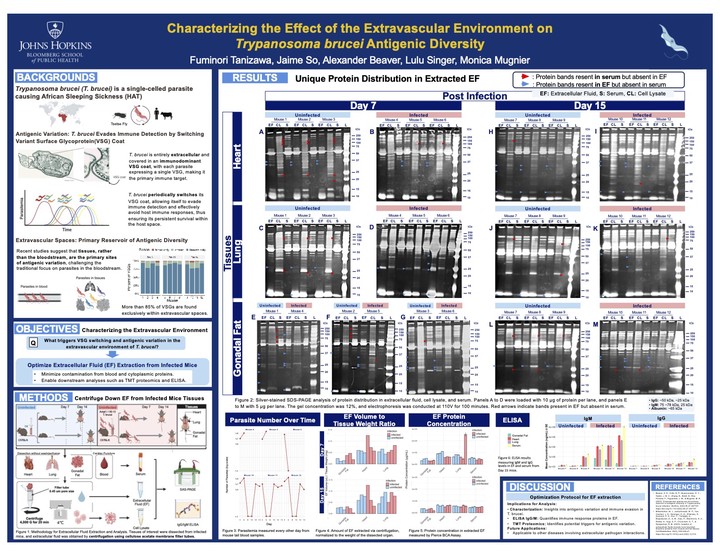
Trypanosoma brucei poses a significant public health and economic burden across sub-Saharan Africa. This single-celled parasite relies on antigenic variation — periodically switching its dense variant surface glycoprotein (VSG) coat — to evade host antibodies and establish chronic infection. While most research has focused on bloodstream-stage parasites, recent evidence suggests that the primary reservoirs of antigenic diversity reside in extravascular spaces, the fluid-filled gaps between tissue cells. Understanding what triggers VSG switching in these microenvironments is critical for elucidating the parasite’s immune evasion strategy.
In this project, I optimized a protocol for extracting extracellular fluid (EF) from infected mouse tissues for downstream analyses including TMT proteomics and ELISA. I dissected adipose tissue, heart, and lung, then tested centrifugation speeds, washing, and perfusion techniques to maximize EF yield while minimizing cytoplasmic contamination from tissue damage. SDS-PAGE confirmed that the resulting EF contained a protein profile distinct from both cell lysate and serum. These findings provide a reproducible and standardized method for characterizing the extravascular environment, laying the groundwork for future studies of T. brucei immune evasion and persistence in host tissues.

Fuminori Tanizawa
PhD Student
PhD Student in Computational and Systems Immunology at Stanford Medicine, studying malaria immunity