Senior Thesis Research, Harvey Mudd College — Awarded the Mindlin Prize
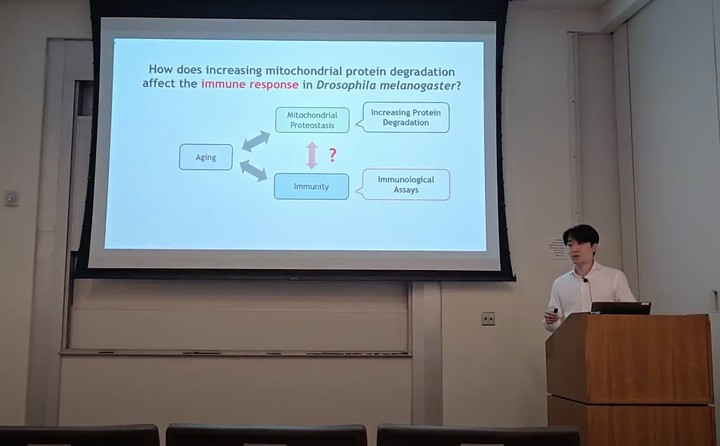
- Investigated how mitochondrial proteostasis influences innate immunity in Drosophila under the supervision of Professor Jae Hur.
- Established immunological assays (bacterial load measurements, antimicrobial peptide expression) to test whether ClpXP overexpression enhances pathogen resistance and longevity.
- Conceived and executed the project independently, introducing immunological approaches into a lab focused on the molecular genetics of aging — from literature review through experimental design, data collection, and manuscript preparation.
Abstract
Aging and immunity are intimately linked processes, yet the specific role of mitochondrial protein quality control in immune function remains poorly understood. This project examines how enhanced mitochondrial protein degradation affects the innate immune response in Drosophila melanogaster. Mitochondrial proteostasis — the maintenance of protein quality within mitochondria — has been associated with extended lifespan and delayed aging, and given that aging is also accompanied by immune decline, understanding this relationship may reveal novel insights into the aging–immunity interface.
Using a Drosophila model overexpressing the mitochondrial protease ClpXP via an RU486-inducible GeneSwitch system, I optimized and validated bacterial infection, survival, bacterial load, and antimicrobial peptide (AMP) induction assays using Serratia marcescens Db11, a Gram-negative entomopathogen. While robust immune activation was observed following infection, ClpXP overexpression did not significantly alter survival, bacterial clearance, or AMP expression. These findings suggest that improving mitochondrial proteostasis alone is insufficient to enhance innate immune resistance under acute infection, but may contribute to organismal resilience through other mechanisms linked to aging and cellular stress responses.

Fuminori Tanizawa
PhD Student
PhD Student in Computational and Systems Immunology at Stanford Medicine, studying malaria immunity