Sleep contributes to preference for novel food odours in Drosophila melanogaster
Two-Year Project — Shizuoka University, Japan, with Dr. Hiroyuki Takemoto
- First-authored publication in Scientific Reports ( link)
- Presented orally at the International Animal Behavior Society and by poster at two domestic conferences
- Won two national high school biology competitions
- Conducted as a visiting researcher while in high school, funded by the Japan Science and Technology Agency
Abstract
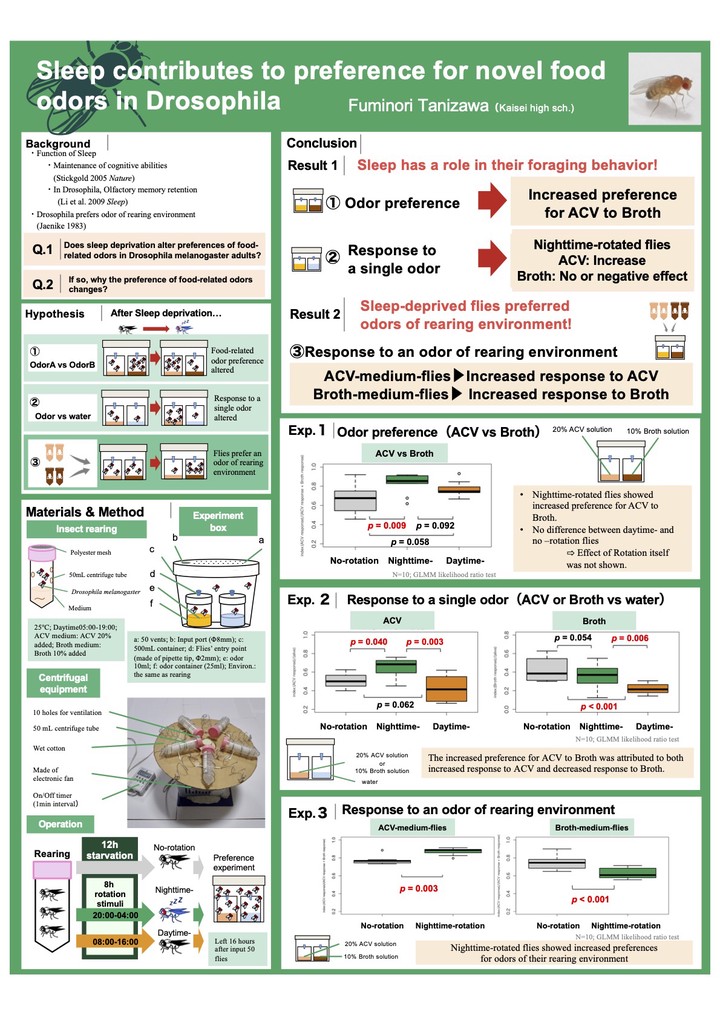
The importance of sleep for cognitive functions such as learning and memory is well established across vertebrates and invertebrates. Prior work showed that sleep deprivation impairs olfactory memory retention in Drosophila melanogaster in classical conditioning paradigms. Here, we demonstrate that sleep deprivation also alters food odor preference. Flies disturbed with periodic rotation stimuli during nighttime preferentially chose apple cider vinegar (ACV) over broth — an effect absent in undisturbed controls and in flies rotated during the daytime. Single-odor experiments confirmed that sleep deprivation specifically increased attraction to ACV. Furthermore, flies reared on ACV-supplemented medium showed stronger ACV preference under sleep-deprived conditions, and the reverse was true for broth-reared flies. Collectively, these results suggest that sleep deprivation reduces preference for novel odors and increases attachment to familiar rearing-environment cues. This study provides a new framework for investigating the interaction between sleep and neural processes underlying novelty detection and cognitive flexibility.

Fuminori Tanizawa
PhD Student
PhD Student in Computational and Systems Immunology at Stanford Medicine, studying malaria immunity