- Behavior
- Neuroscience
Sleep contributes to preference for novel food odours in Drosophila melanogaster
Takemoto Lab · Shizuoka University — JST Global Science Campus · Shizuoka, Japan · Jul 2018 – Apr 2021
Visiting High-School Researcher · Dr. Hiroyuki Takemoto, Research Institute of Green Science and Technology
Question
Does sleep change which food odors fruit flies prefer?
What I did
- Led a two-year independent project in high school
- Built a sleep-deprivation rotator, a two-choice odor box and an infrared activity monitor
What I found
Sleep-deprived flies favored familiar odors over new ones. Published as a first-author paper in Scientific Reports (2021).
Methods Behavioral assays · Custom apparatus
Organism Drosophila melanogaster
Recognition Two national Grand Prizes and ministerial awards (Japan)

Background
Sleep is known to support learning and memory, and losing sleep impairs odor memory in fruit flies. Whether sleep also shapes everyday choices — like which food smell to approach — had not been tested.
What I did
As a high-school visiting researcher (JST Global Science Campus, Shizuoka University), I designed the study and built the equipment: a rotator that disturbs sleep at night, a two-choice odor box, and an infrared activity monitor.
What I found
Flies disturbed at night preferred apple cider vinegar over broth, while undisturbed flies and flies disturbed in the daytime showed a much weaker preference. Flies reared on one odor preferred that odor more strongly after sleep loss — so sleep deprivation seems to reduce interest in new odors and increase attachment to familiar ones. The work was published in Scientific Reports and presented at the Animal Behavior Society meeting.
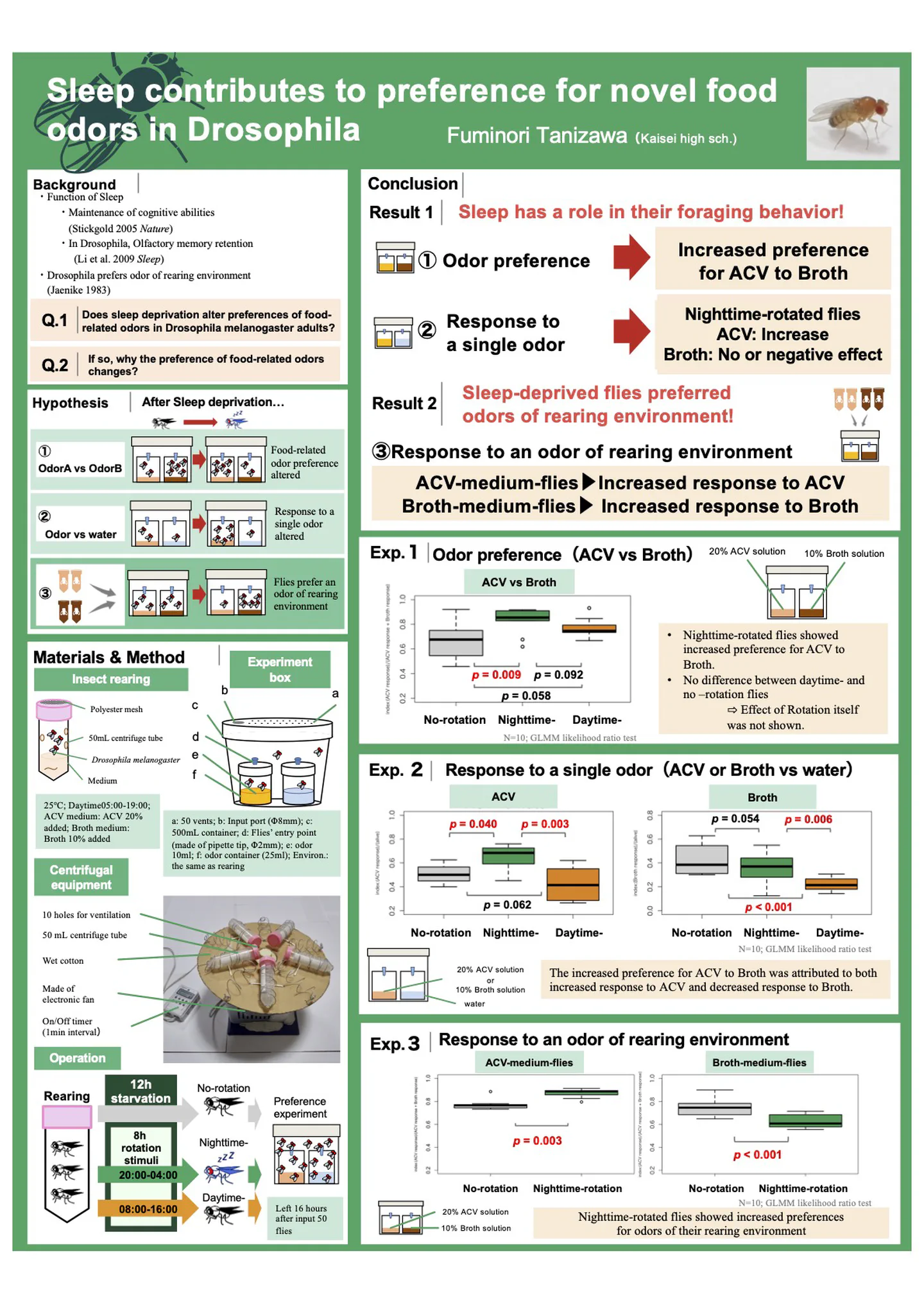
Click to open the PDF.
From this project
Sleep contributes to preference for novel food odours in Drosophila melanogaster
Scientific Reports. 2021. doi:10.1038/s41598-021-88967-1
Sleep and Novel Odor Preference in Drosophila melanogaster
Biophysical Society of Japan Annual Meeting, Japan (Virtual), September 2020.
Sleep Deprivation Alters Food Odor Preference in Drosophila melanogaster
Animal Behavior Society Annual Meeting 2020, Virtual (USA), July 2020.